What are we missing?
Bring competing proposals, customer evidence and operational constraints into one comparison. Ask for the strongest objection to your preferred option and the fact that could change your mind.

Give your judgment better material to work with, and give yourself more time to use it.
Book a free 20-minute call
An answer is useful only when it reflects the business you’re actually running. Learn how to give AI that context, then put it to work on questions like these.
Bring competing proposals, customer evidence and operational constraints into one comparison. Ask for the strongest objection to your preferred option and the fact that could change your mind.
Turn your approved reasoning into a concise explanation for the people carrying it out. Make the trade-off, owner and next checkpoint explicit, without losing the context behind the choice.
Use AI to assemble meeting pre-reads, draft routine replies and pull outstanding commitments from material you provide. Reserve your attention for exceptions, relationships and decisions that need your judgment.
An illustrative exercise: your team wants to release a product update on Friday. Sales sees demand. Product has a known issue. Support has limited capacity. Here’s the comparison AI could prepare from that evidence.
Three requests show interest, but don’t establish broad demand. An unresolved setup issue could create work beyond the five accounts Support can cover.
Is the issue acceptable for wider use? Get its severity and likely support load before treating Friday as a go decision.
A pilot of the three interested customers would fit the stated account limit. Their willingness to test and their setup needs are still unknown.
Which customers are suitable? Agree entry criteria, an accountable owner and a stop condition before inviting anyone.
Waiting avoids releasing with the known issue. The packet gives no fix estimate or evidence of a contractual deadline, so the cost of delay is unclear.
How long is a reasonable wait? Ask for a fix estimate and check whether a customer commitment exists outside this packet.
The evidence packet. This comparison uses only four supplied facts: three access requests, an unresolved setup issue, support for five pilot accounts, and a proposed Friday release. It does not know the issue’s severity, customer consent or fix date.
You leave with sharper questions and explicit trade-offs. Once you choose, AI can draft the rationale and next steps for your team to review.
Choose a question with at least two plausible options. Use a small packet of approved material: proposals, dated updates, customer evidence or operating constraints. Replace the brackets below. A capable chat tool with document support is enough to try this; it has no access to company information unless you provide or connect it.
Hello Aristotle
Help me examine [decision] by [deadline]. My options are [options, including keeping things as they are]. My priorities are [criteria]. These constraints must be respected: [constraints]. First ask about missing information that could change the comparison, then wait for my reply. If I cannot supply it, keep it unknown and make the comparison provisional.
Use [approved documents or pasted facts, each with a name and date]. Tie factual statements to a source name and passage. Separate supplied facts, assumptions and unknowns. Point out conflicting or outdated information. Do not invent figures, preferences, commitments or probabilities.
Make a concise table: option; evidence for it; strongest objection; missing evidence; next question and who could answer it. Give my preferred option [option or undecided] the same scrutiny as the others. Explain which new fact could reverse the comparison. Do not make the final decision for me.
Stop for my review of the sources and trade-offs. After I supply a decision, draft a short rationale for [audience], stating the chosen action, accepted trade-off and [owner/checkpoint, if confirmed]. Keep unresolved items visible. Do not send messages, change records or commit anyone to an action.
Work alongside a facilitator on something you need to think through. The aim is to understand the method well enough to repeat it when the next unfamiliar question arrives.
Name the decision, who owns it and which constraints matter. Gather a small, current evidence packet. This prevents a broad question from producing a confident answer to the wrong problem.
Build the comparison, inspect its sources and probe its weak spots. Adjust the instructions when the tool skips a trade-off or simply agrees with you. Notice which corrections make the answer more useful.
Retain your decision-brief structure, source checklist and useful instructions. Try them on fresh material during practice so you can see what transfers and what still needs adapting.
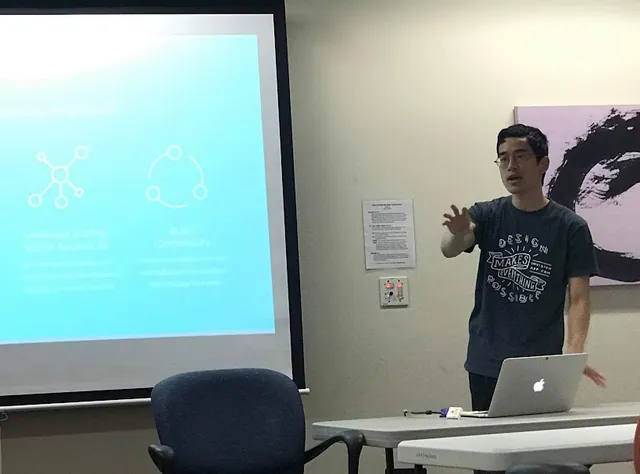
Our facilitators are business operators. Bring the messy notes, the recurring requests, the thing you keep putting off. We’ll work through it together.
You’ll practice on tasks that matter to you, with useful examples and instructions to keep building on.
Meet Sydney Liu →
Co-founder & CEO · ThoughtFlow.ai
“Before Hello Aristotle, AI was something I had to sit down and drive every time. Now it runs entire workflows on autopilot. I get my time back, and the results are better than when I did it by hand.”

Executive Coach · Former COO & Chief of Staff
“I’m non-technical, and I felt intimidated trying to organize my knowledge for AI. Within 48 hours of working with Hello Aristotle, my workflows and how I engage with AI were completely transformed. I couldn’t have done it without them.”
Start with a free guide. Give AI the context behind your work, then build a routine you can use again.
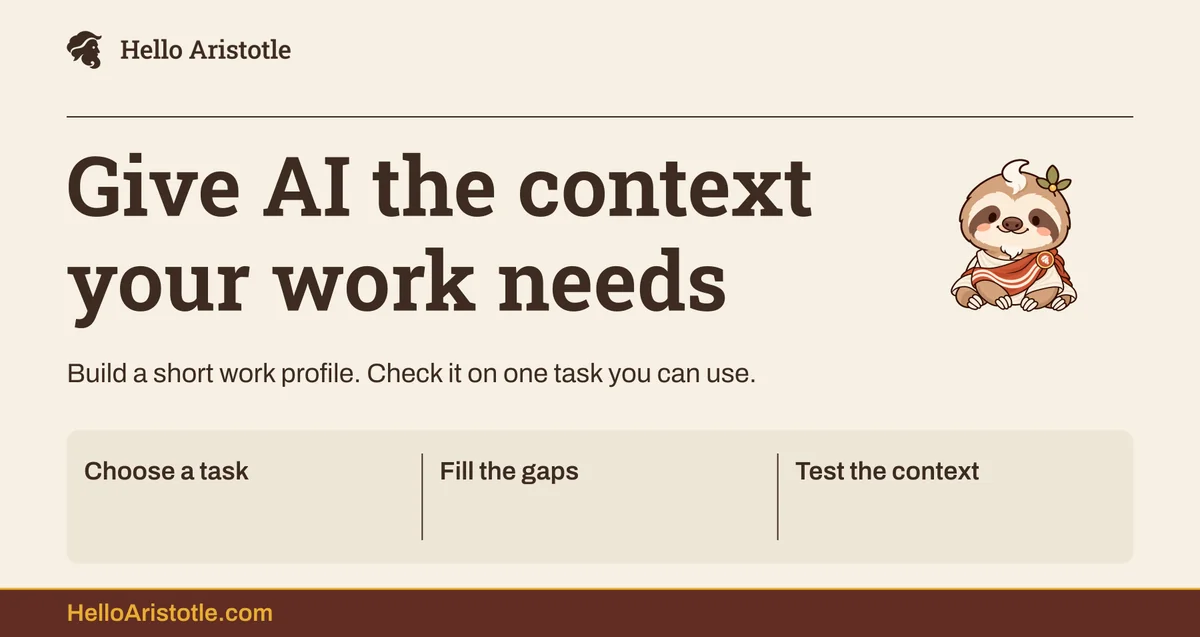
Turn selected notes, documents and emails into a useful work profile. Let AI find the gaps, ask you better questions and save the context for next time.
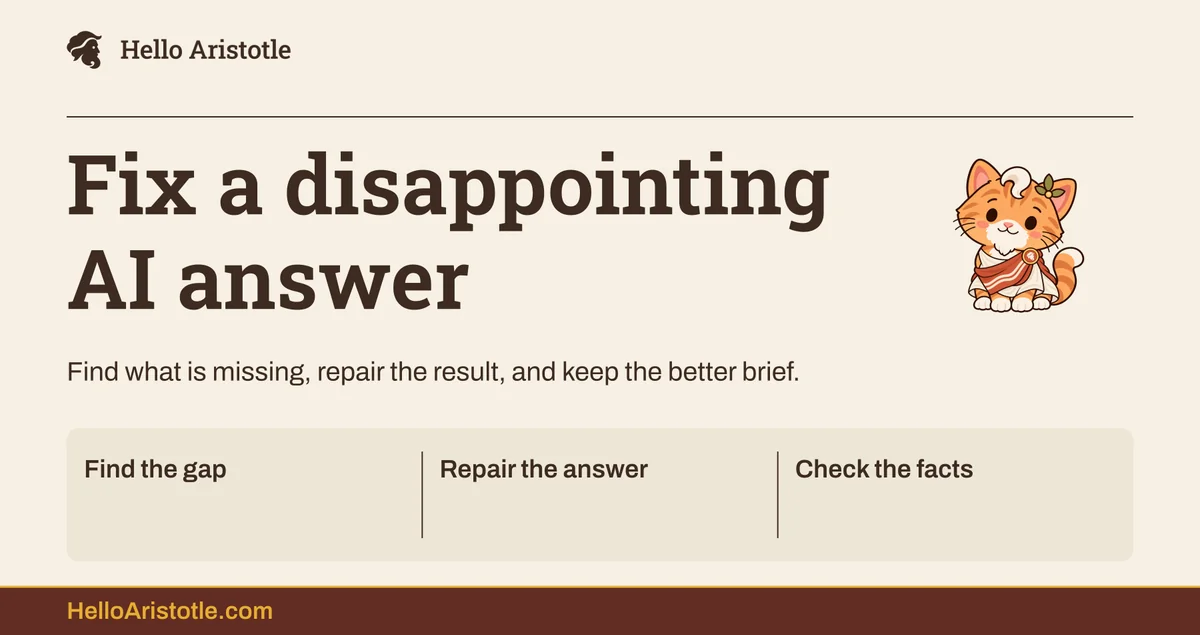
Find the missing context, improve the brief and get a better answer. Use one repair prompt, then keep the lesson for the next task.
Yes. If you’re getting summaries and drafts but struggling with a consequential question, there’s plenty to work on. We can focus on evidence selection, competing explanations and how to make the reasoning inspectable. If you’re newer, we’ll begin with the basics needed for your chosen task.
The focus here is practicing AI on your own work with live guidance. A broad course may be a better match if you want a formal curriculum on AI strategy, governance or technical foundations. Tell us which capability you want to develop so we can be clear about the fit.
Absolutely. A shared decision can be a useful place to practice: each leader brings different evidence, tests the comparison and sees how the reasoning changes. We’ll agree who participates and what material can be shared before planning a group session.
We’ll start with the task and your permitted tools. For an exercise like the one above, a chat tool that accepts your approved documents or pasted context is sufficient. Integrations, subscriptions and automated actions depend on your account and access; they’re discussed separately, never assumed.
We scope the training around your starting point, the work you want to practice and whether you’re learning individually or with colleagues. Price, session length, delivery format and any follow-up support are agreed before you book paid training. The introductory 20-minute call is free and gives us room to suggest where to begin.
You remain responsible for the call. We teach you to examine what the tool produces, including the evidence it misses. Routine preparation can be delegated more readily, but any connected workflow needs defined access, checks and approval before it sends something or acts on your behalf.
Aristotle Certificates mark demonstrated proficiency milestones connected to real work. They aren’t an accredited qualification or an employer certificate. The emphasis is on a capability you can put to use, taught by people who operate businesses; we don’t promise a university credential or employer recognition.
One live question is plenty. You don’t need a polished presentation or an AI strategy document.
A choice you can explain. Describe the options and why the decision matters. A low-stakes planning question is a good first exercise if your current decisions involve sensitive material.
Evidence you’re allowed to use. Select approved excerpts or remove confidential details. Follow your organization’s rules for the chosen tool; using AI does not change who may access the information.
Your current setup. Let us know which AI account you have and any company restrictions. We’ll establish what can be practiced with that access before agreeing the session.
Tell us what you’re weighing up and where the preparation gets in the way. We’ll explore a useful starting point for learning AI around that work.
Book a free 20-minute call